 Graylog: Configuring email notifications
This documentation is part of the Alerting guide. You can view the complete guide here: How to send Graylog alerts by email, Slack, or Mattermost.
👋 Welcome to Stackhero documentation
Stackhero offers a fully managed Graylog cloud solution designed for speed and simplicity. You can:
- Count on an unlimited, dedicated SMTP email server included with your service.
- Apply updates easily with a single click, with no manual intervention required.
- Use a custom domain name secured by HTTPS (for example, https://logs.your-company.com), providing your team with secure, direct access.
- Benefit from strong performance and security on a private, dedicated infrastructure with no shared resources or noisy neighbours.
Focus on your data, not your tools: you can get started with Stackhero's Graylog cloud hosting solution in just a few minutes.
Every Graylog instance provided by Stackhero comes with a built-in email server, allowing you to send unlimited emails directly from your instance at no extra cost.
To set up an email notification, you can follow these steps:
-
Access your Graylog service, go to
Alerts>Notifications, and click theGet started!button or selectCreate notification. -
Enter a title for your notification and select
Email NotificationunderNotification type. -
In the
Senderfield, enternoreply@<yourGraylogDomain>. Make sure to replace<yourGraylogDomain>with your actual Graylog domain name, which is usually in the format<XXXXXX>.stackhero-network.com.Important: Be sure to use your Graylog domain to avoid errors when sending emails.
-
Enter the email address where you want to receive alerts in the
Email recipientfield.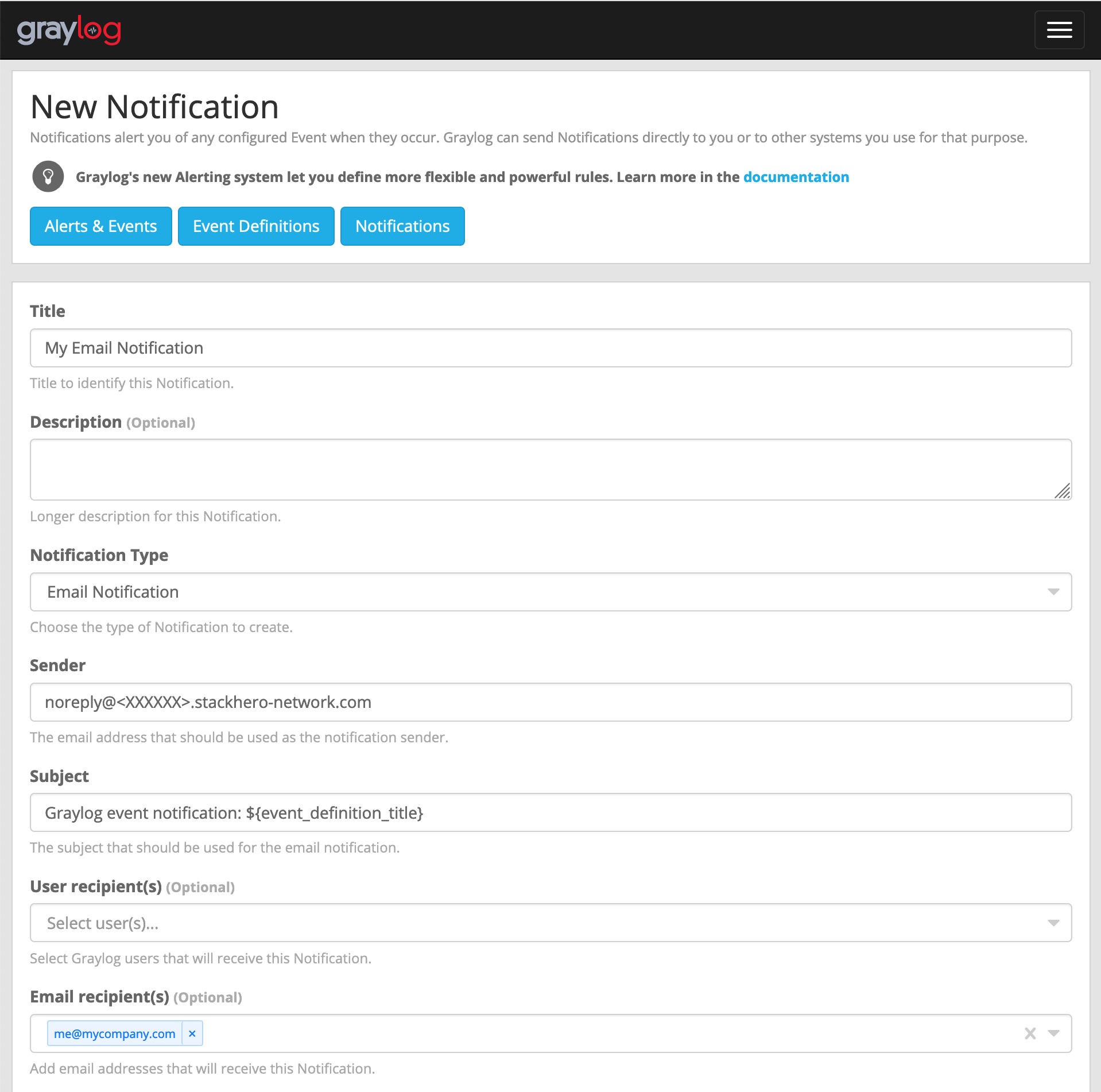 Example of email configuration
 -
Click the
Execute test notificationbutton to check that everything is working properly. Once the test is successful, complete the setup by clickingCreate.
Congratulations! Your email notification is now configured and operational!
Handling the error: "Sending the email to the following server failed: postfix:25"
If you encounter the error Error: Notification has email recipients and is triggered, but sending emails failed. Sending the email to the following server failed: postfix:25, it likely means the sender field is not properly formatted. It should follow the pattern <something>@<yourGraylogDomain>. "Something" can be anything (for example, "noreply"), but "yourGraylogDomain" must match your Graylog service domain, usually in the form <XXXXXX>.stackhero-network.com.