 Graylog: Alerting
How to send Graylog alerts by email, Slack, or Mattermost
👋 Welcome to Stackhero documentation
Stackhero provides a fully managed Graylog cloud solution designed for speed and simplicity. You can:
- Rely on an unlimited, dedicated SMTP email server included with your service.
- Apply updates effortlessly with a single click, with no manual intervention needed.
- Use a custom domain name secured by HTTPS (for example, https://logs.your-company.com), giving your team secure, direct access.
- Experience strong performance and security on a private, dedicated infrastructure with no shared resources or noisy neighbors.
Focus on your data, not your tooling: you can get started with Stackhero's Graylog cloud hosting solution in just a few minutes.
Graylog empowers you to respond proactively to specific conditions by sending alerts through notifications. These notifications can be channeled via email, Slack, Mattermost, or an HTTP webhook.
For additional insights into alerts, you can refer to the official documentation.
Configure email notifications
Every Graylog instance provided by Stackhero includes a built-in email server, allowing you to send unlimited emails directly from your instance at no additional cost.
To set up an email notification, you might consider following these steps:
-
Access your Graylog service, navigate to
Alerts>Notifications, and click theGet started!button or opt forCreate notification. -
Enter a title for your notification and choose
Email NotificationunderNotification type. -
In the
Senderfield, inputnoreply@<yourGraylogDomain>. Remember to replace<yourGraylogDomain>with your actual Graylog domain name, typically formatted as<XXXXXX>.stackhero-network.com.Important: Ensure you use your Graylog domain to avoid errors when sending emails.
-
Specify the email address where you would like to receive alerts in the
Email recipientfield.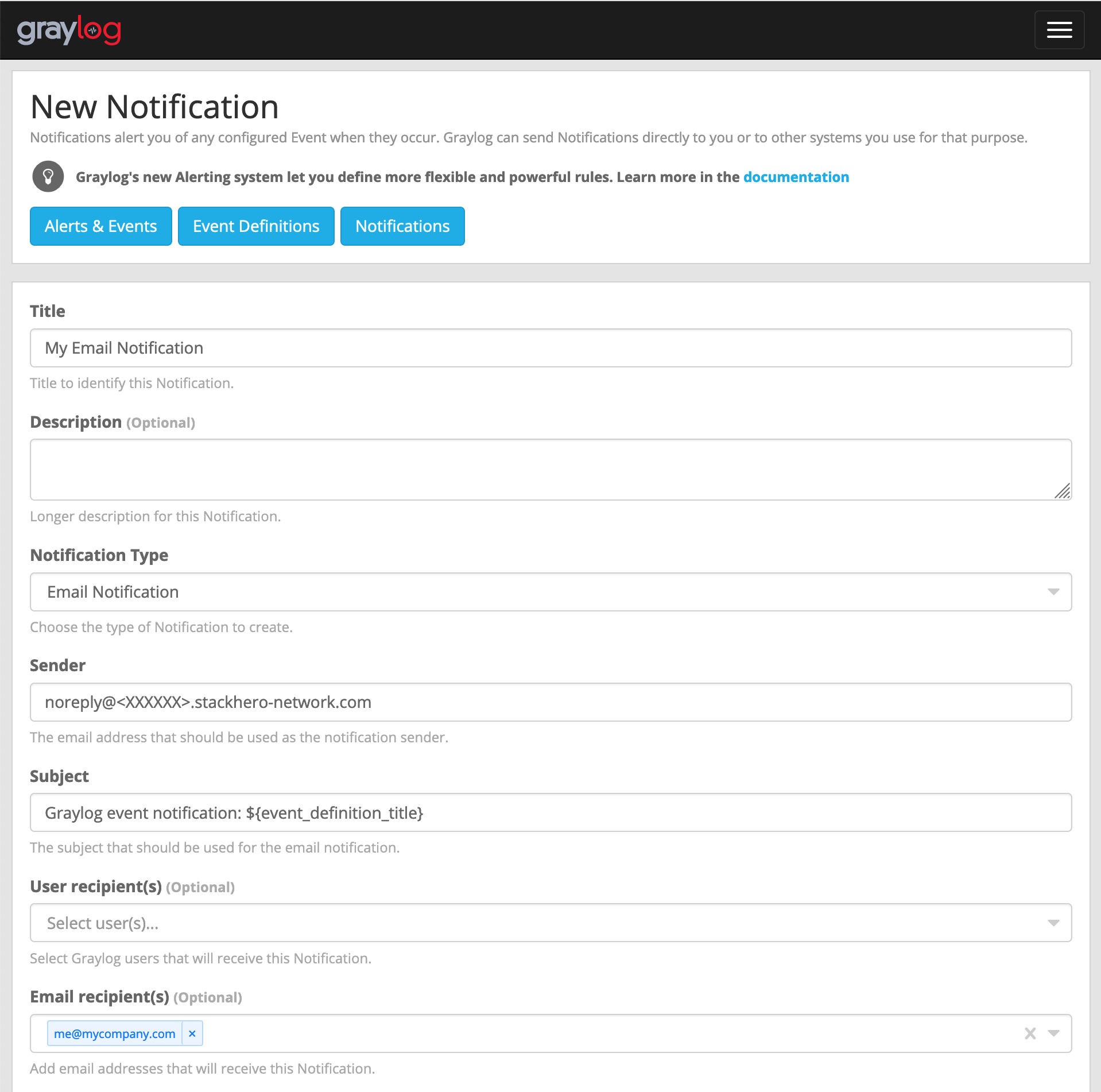 Example of email configuration
 -
Click the
Execute test notificationbutton to verify that everything functions correctly. Once confirmed, complete the setup by clickingCreate.
Congratulations! Your email notification is now established and operational!
Handling the error: "Sending the email to the following server failed: postfix:25"
Should you encounter the error Error: Notification has email recipients and is triggered, but sending emails failed. Sending the email to the following server failed: postfix:25, it is likely because the sender input is not correctly formatted. It should follow the pattern <something>@<yourGraylogDomain>. "Something" is flexible (like "noreply"), but "yourGraylogDomain" must reflect your Graylog service domain, usually presented as <XXXXXX>.stackhero-network.com.
Configure Slack and Mattermost notifications
To set up a Slack or Mattermost Cloud notification, you will first need an "incoming webhook" from Slack or Mattermost Cloud.
Obtain an incoming webhook URL from Slack
For Slack users, visit https://api.slack.com/apps and click Create New App. Complete the form, validate it, then select Incoming Webhooks and enable them. Click Add New Webhook to Workspace and copy the Webhook URL for use in the next steps.
Obtain an incoming webhook URL from Mattermost
If you prefer Mattermost Cloud, the open-source alternative to Slack, navigate to your Mattermost interface. From the main menu, select Integrations, then Incoming Webhooks, click Add Incoming Webhook, and complete the form. You will be given a URL in the format https://<domain>/hooks/<token> to copy for future use.
Configure the notification
Before configuring Slack and Mattermost Cloud notifications, ensure the Integrations plugin is activated in the Stackhero dashboard. To do this, choose your Graylog service, click Configure, activate the Integrations plugin, and confirm the configuration.
Once configured, proceed to your Graylog instance under Alerts, Notifications, and click Get started! or Create notification.
Assign a title and select Slack Notification in Notification type. Paste the incoming webhook URL you obtained from Slack or Mattermost into Webhook URL.
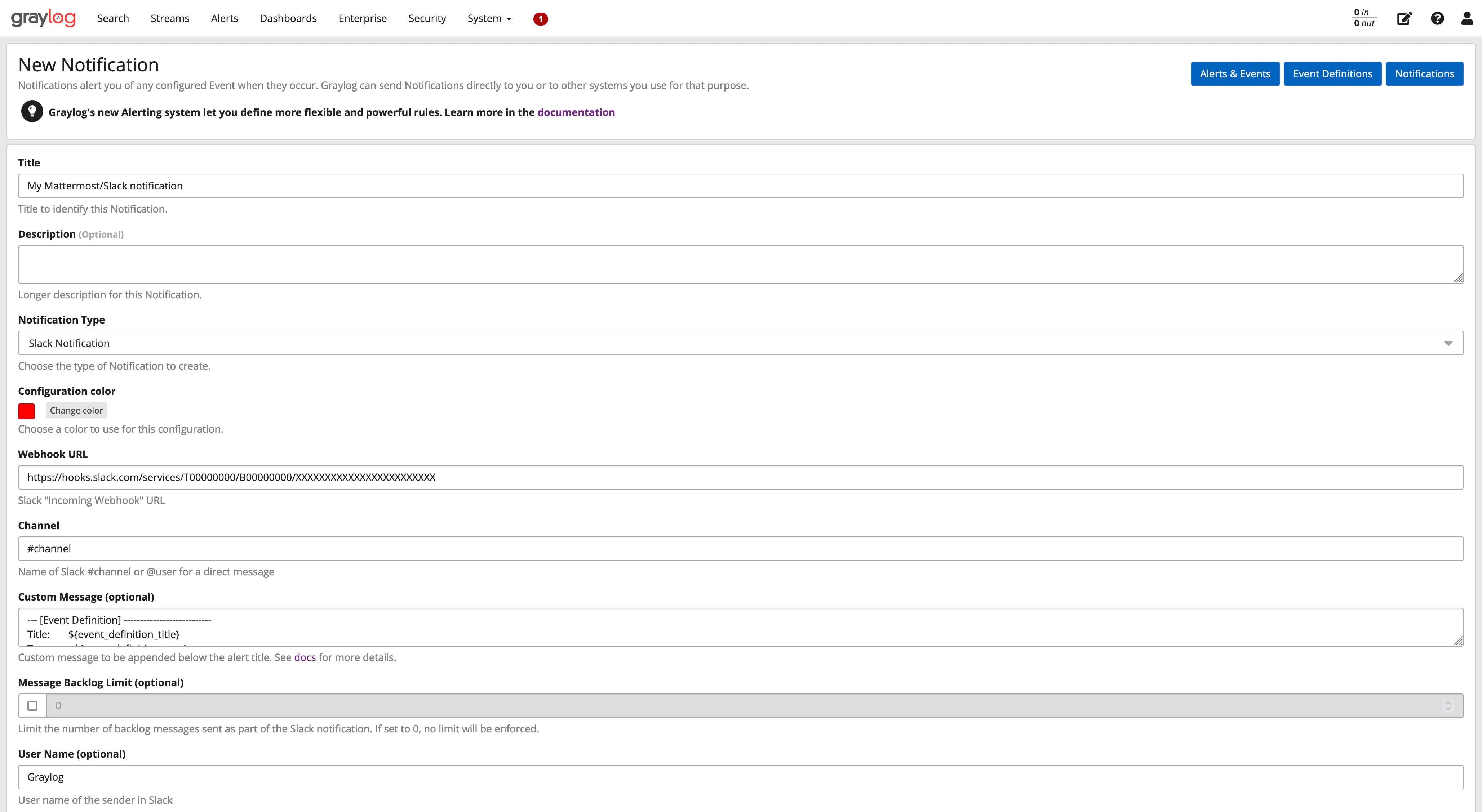 Example of a Slack/Mattermost configuration
Click the Execute Test Notification button to ensure functionality, then finalize by clicking Create.
Congratulations, your Slack/Mattermost notification is now set up and ready for action!